

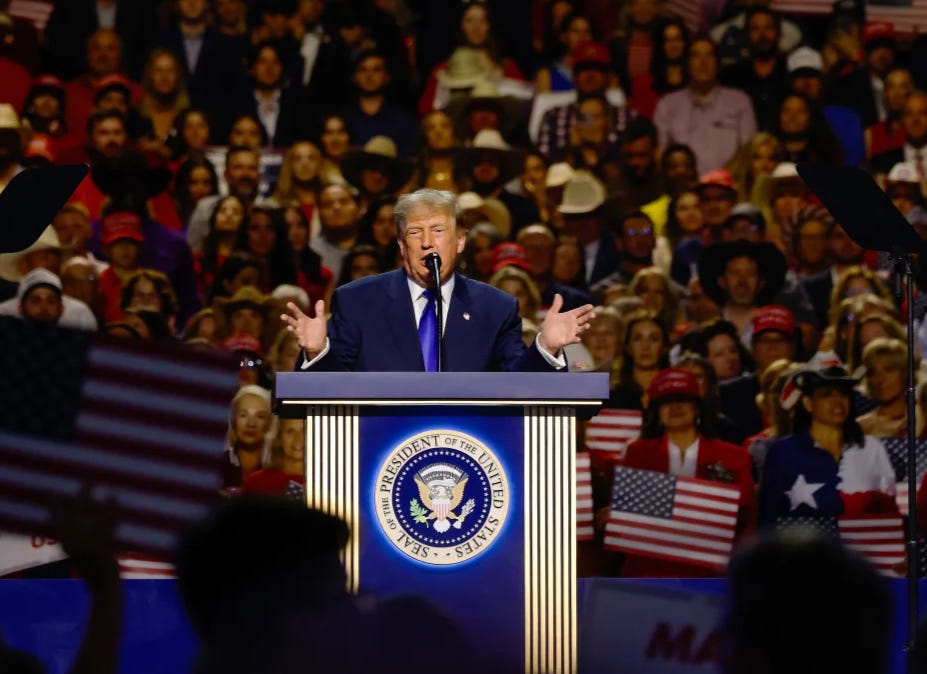
On September 9th, President Donald Trump put forth an “offer” to extend a $5,000 “dividend” to American citizens. Setting aside the questionable terms and Constitutionality of the proposed stimulus payment (as they are tied to upcoming mid-term election results), the proposal does appear aimed at providing relief to households challenged by ongoing affordability issues.
The estimated cost of this proposal is likely over $1 Trillion, and is likely to be made possible with further deficit spending, so it is important to know if its potential economic impact can also be evaluated. This impact should also be evaluated across income levels and in comparison to the influence created by other forms of Federal spending.
Research published last year in Public Budgeting & Finance from Jaeger Nelson and Matthew Wilson of the Congressional Budget Office offers a model for potentially answering these pertinent questions. Their concepts, the Federal Fiscal Impulse (FFI) and Federal Fiscal Impulse Index (FFII), are intended to measure how changes in fiscal policy at the national level can create changes in economic activity, as measured through Gross Domestic Product (GDP) within the immediately following fiscal quarters.
Depending on the eligibility criteria used to determine who would receive the hypothetical $5,000 per person disbursements, applying the research suggests lower income recipients would generate the most positive, short-term impact on economic growth. FFII findings also show that the impact would not exist for long and would lead to a subsequent decline compared to the path of previous policy, while overall economic growth impact would remain positive on an annual basis (and none of this factors other effects, including those on the growing issue regarding the national debt).
Narrowing Focus of Prior Efforts
Nelson and Wilson’s work builds upon research and models developed over the past two decades to understand the economic impact of changes in government fiscal policy. Building on the work of Federal Reserve researchers Glenn Follette and Byron Lutz understanding the “Fiscal Impetus” of discretionary government spending, David Cashin, and others with respect to fiscal effects, and further development of the Fiscal Impact Measure (FMI) by the Hutchins Center of Brookings, Nelson and Wilson isolate the impact of Federal Policy to provide a path to increased understanding specifically on Washington’s decisions with respect to taxation, agency appropriations, and transfer payments to citizens, localities, and States.
Nelson and Wilson define FFI as “direct short-term effects of changes in federal fiscal policy through its effect on aggregate demand.” The purpose of the FFII, therefore, is to measure the increment of impact on Real GDP growth created by specific changes in fiscal policy. This can be effectively measured on a quarterly basis to identify positive and negative swings with respect to when policies take effect (i.e., timing of stimulus payments) and the duration of their effect compared to what would have taken place under policy conditions prior to the most recent change(s).
Their work involves initial research categorizing total Federal impact into 3 broad categories: Federal government purchases, grants to state and local governments, and taxes and transfers to individuals. Further subcategorization of taxes and transfers enabled their application of weights to control for relationships in the value for each subcategory. These classifications first enable evaluating decomposition of past Real GDP Growth, providing a basis for establishing and measuring the Federal Fiscal Impulse Index.
Stimulus is Impulsive
Nelson and Wilson’s research includes evaluation of Federal policy with respect to actual receipts (revenues) and outlays (expenditures) for Calendar Years 2019 to 2024, and as projected through 2026, as guided through outlooks published by the CBO. Interestingly enough, the CBO’s estimate of average annual GDP from the Fourth Quarter 2024 to Fourth Quarter 2026 (2.1%) is very close to the actual average recorded so far by the Bureau of Economic Analysis (2.2%).
Analysis of Real GDP growth decomposition finds that transfers oriented towards the lower income group (such as TANF) produced noticeable positive impact on GDP growth, with the weakest impact coming from transfers impacting the highest income group. Subsequent historical evaluation found that FFII was more noticeable as a result of the COVID-influenced stimulus policy, especially on a quarterly basis, than policies taken in response to the 2008 global financial crisis. Given how the COVID response focused more transfer payments to lower income individuals, the results appear consistent with the findings from growth decomposition.
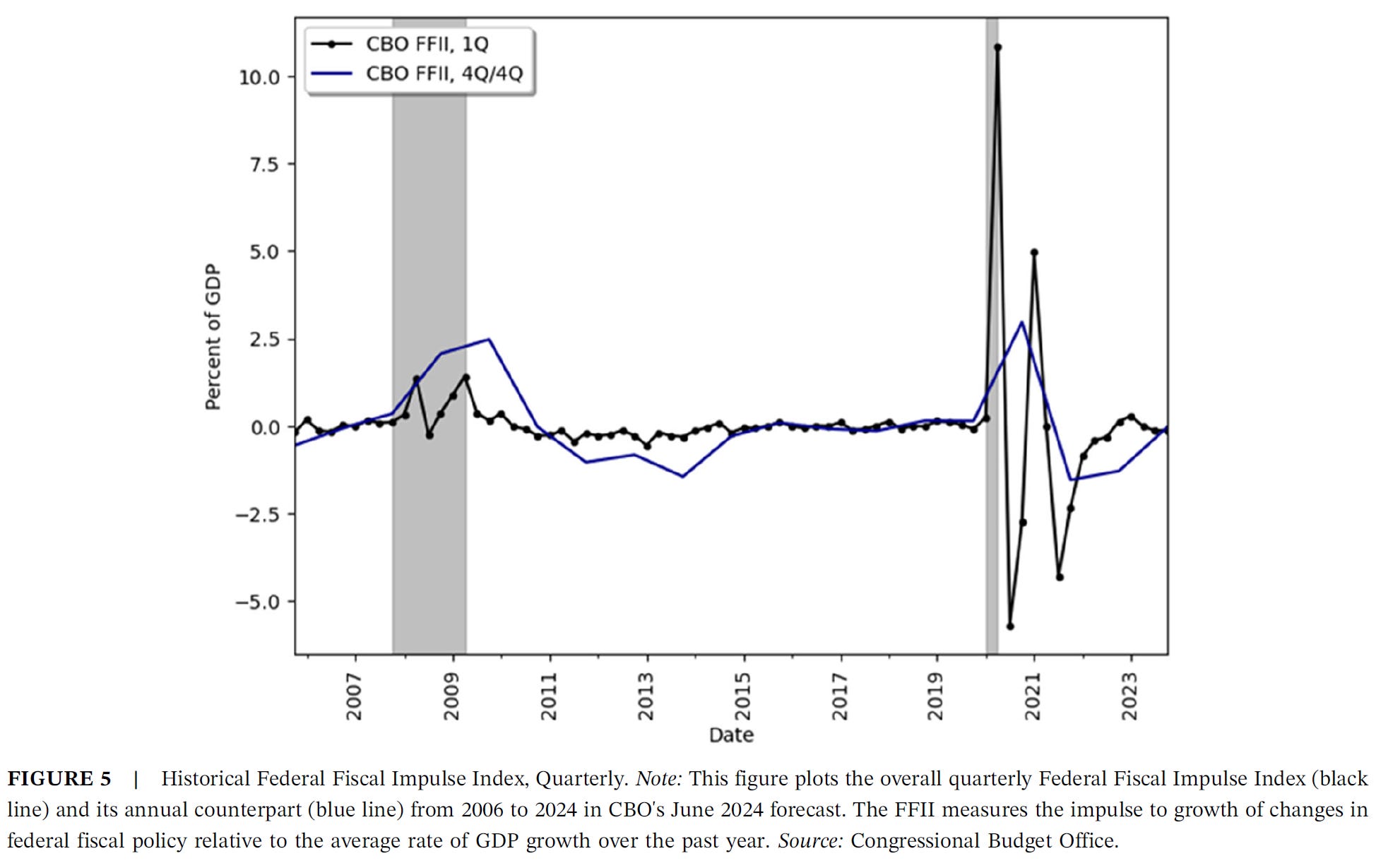
Quarterly measurement of FFII also provides a stronger understanding of the volatility stimulus-oriented policies can have with respect to their influence on demand. While the actions are likely to create a positive growth measurement on an annual basis, comparing impact in shorter increments indicates greater fluidity.
“The quarter‐to‐quarter nature of the FFII causes some periods, such as 2020q3 and 2020q4, to reflect a drag on growth despite higher‐than‐normal levels of spending. This is because those higher levels of spending have decreased relative to the previous quarter when spending was even higher. Such results highlight that the FFII captures the contemporaneous impulses to aggregate demand and their effect on near‐term GDP growth. This contrasts with the more complete fiscal policy analyses found in CBO’s usual reports that analyze the effects of policy changes relative to an economic baseline.”
What could the “Dividend” Do?
Nelson and Wilson are careful to limit their contributions to FFI and FFII to “short-term analysis of the direct impulse in aggregate demand coming from changes in federal fiscal policy.” Therefore, any simulation of their concepts can only (at best) provide us with a forecast of impact for one to two quarters.
“Though the fiscal impulse measures are not a complete picture of the effects of fiscal policy, they are nevertheless a useful way to compare the stance of fiscal policy against itself over time, such as in the examples above. These comparisons may be useful for policy analysis. For example, the significant differences in the quarterly FFII in the last two recessions may help explain how the economy responded differently in each episode. We expect the FFI and FFII to be useful tools for policymakers and forecasters who are assessing how federal fiscal policy has evolved over time and how it is projected to evolve in the future in relation to the growth of GDP.”
More than likely, the White House and Congressional Leadership will not incorporate FFI or FFII into the movement on potential stimulus actions between now and the end of 2026, as this concept appears to be a political maneuver. Regardless, Nelson and Wilson’s development of methodology to specifically evaluate the impulse effect of Federal fiscal policy with respect to economic impact does provide a starting point for further evaluation of future proposals, especially those seeking to generate immediate results.
Nelson and Wilson’s article, “Understanding the Relationship Between Changes to Federal Fiscal Policy and Near-Term Real GDP Growth,” appears in Issue 45(1) of Public Budgeting & Finance. The authors’ additional work on FFI and FFII is available in a Working Paper published by the Congressional Budget Office.