


Upcoming elections include measures in more than a dozen states to broadly or selectively limit application of property taxes by their local governments. While these preemptive measures up for voter consideration are in response to citizen demands for tax relief and growing public pressure to address household affordability, it is also important to evaluate the proposals with respect to their influence on homeowner behavior following adoption and implementation.
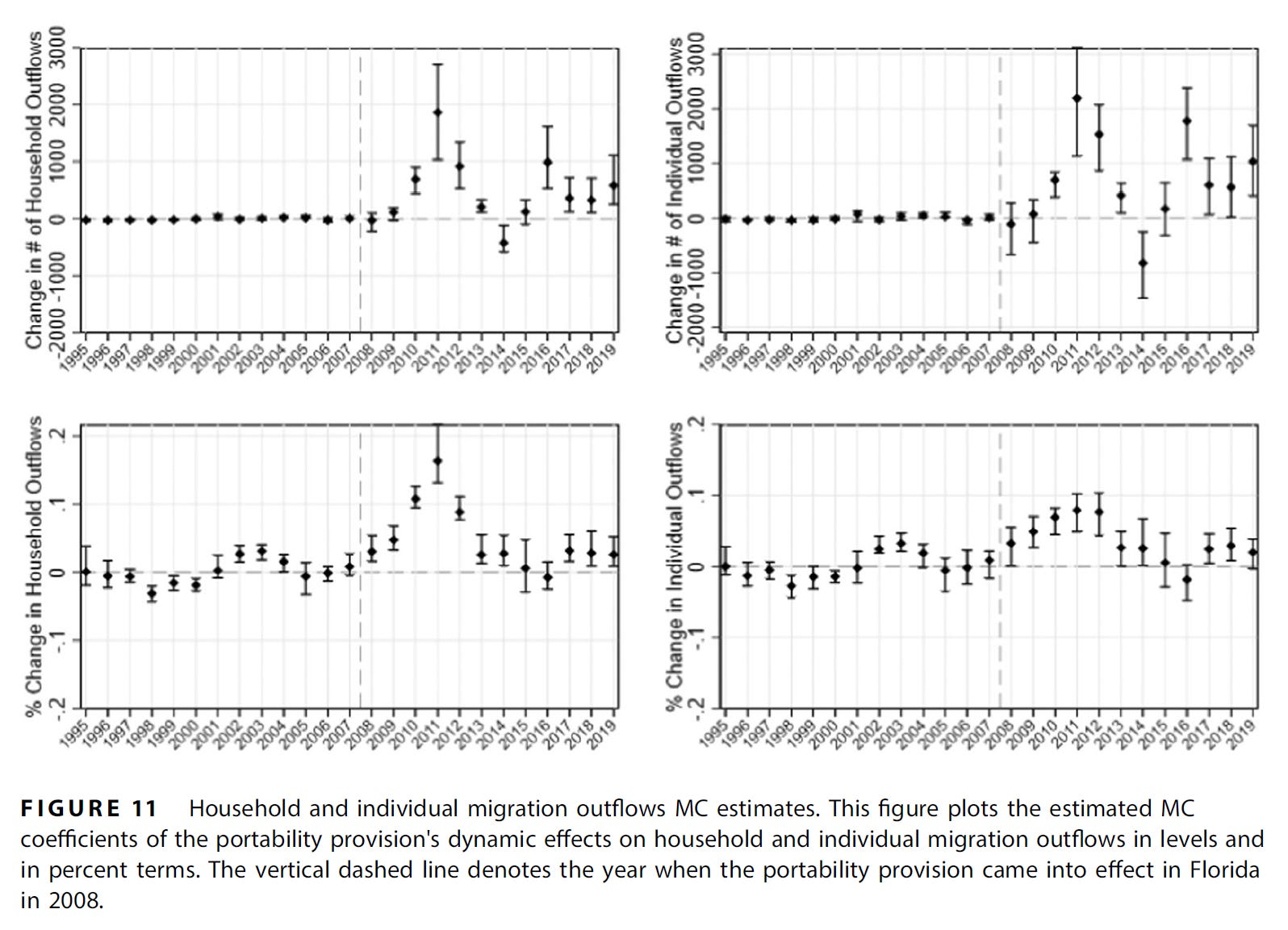
Recent research from Stuart P. DiDonato and Antonios M. Koupias studies the influence of Florida’s expansion of property value assessment limits, which starting in 2008, enabled residents to transfer existing benefits from one residence to another within the state. Their work concludes that the in-state portability of benefits from these assessment limits positively contributed to migration into other counties of the state by approximately 4.8% for households and 3.5% for individuals.
Checking the Results
Findings of this nature require considerable validation, which DiDonato and Koupias performed through a variety of techniques. First, their model intentionally removes California, due to the fact it is the only other state with similar structures in place to facilitate benefit portability, along with the noncontiguous states of Alaska and Hawaii. Next, the authors applied multiple models to test their results.
Utilizing difference-in-difference (DID) estimation with incorporation of event-study falsification tests did not confirm that the establishment of benefit portability in 2008 was responsible for changes of measured migration. However, matrix completion (MC) evaluation of patterns over time between counties for Florida and the 46 remaining states successfully confirmed the effect of the Sunshine State’s voter-adopted property tax policy. Sensitivity analysis involving comparison of other influences further proved the validity of this paper’s findings and established a positive relationship for migration with attraction to natural amenities.
Applying to Evaluating Policy
Drawing from these findings, DiDonato and Koumpias calculated strong mobility elasticity resulting from the effect of benefit portability. The authors also acknowledged that these results do not necessarily benefit the broader population across demographics, with capabilities for evaluating individual incidence limited by the nature of available data. Nevertheless, the research does encourage further investigation, as well as application by state governments seeking to expand likelihood of mobility and growth for their residents.
“The study findings support the view that the portability provision is an effective policy to alleviate the “lock‐in” effect of property value assessment limits on migration and stimulate in‐state mobility that improves in‐state allocative efficiency. Future research should examine the effectiveness of the portability provision in retaining a state’s population by redirecting potential out‐of‐state movers to in‐state relocations.”
DiDonato and Koumpias’ article, Effects of property value assessment limit portability on migration outflows, appears in issue 44(4) of Public Budgeting and Finance.