


When the Affordable Care Act (ACA) was adopted in 2010, expanding Medicaid to low-income adults was established as a requirement for States. Two years later, a Supreme Court decision made it optional.
Nevertheless, what remained was an incredibly generous deal in American fiscal federalism: Washington promised to cover the full cost of newly eligible Medicaid enrollees for the first three years, and then 90 percent thereafter.
As of today, ten states are still exercising their option to decline expansion. New research from Laura Montenovo, Kosali Simon, and Coady Wing compares Medicare reimbursements and finds that counties in expansion states gained an average of $361 per resident, per year, in additional federal Medicaid transfers. Their research further finds that non-expansion states would have received $554 per resident more with expansion.
As Montenovo explains in the article:
“Our estimates speak to debates about program take-up. Counties with the largest potential benefits are disproportionately located in non-expansion states, suggesting partisan and administrative factors dominate state adoption decisions over expected financial gains.”
The Impact of ACA Expansion
The varying timeframes when states adopted Medicaid expansion, and the lack of expansion by others, provide researchers with more than a decade-long natural experiment to examine and draw conclusions .
As Montenovo writes, the resulting body of work indicates that insurance coverage as a result of the ACA increased substantially. This was primarily due to Medicaid expansion. Successive research also found measurable gains in health metrics for low-income populations in states that proceeded with Medicaid expansion.
Unfortunately, the financial implications of Medicaid expansion are less comprehensively explored than health outcomes. This lack of knowledge led to the research of Montenovo and her team examining how federal transfers translate into fiscal resources at the county level.
Understanding Medicaid Reimbursements
Researchers paired transfer estimates with actual IRS data on federal income tax collections at the county level. The relationship is strongly consistently inverse: for every 1% increase in a county’s income tax contributions, ACA-related Medicaid transfers reduce by ~0.86%.
Montenovo’s research establishes a general observation that, the top 20% of counties by federal Medicaid receipts were disproportionately in the bottom 20% of federal tax contributors.
“The ACA expansion was indeed progressive and redistributed resources from high-income individuals to lower-income individuals.”
Concretely, researchers estimate the expansion added roughly 7,300 new Medicaid enrollees in the average county, corresponding to ~7% of an average county’s population.
Moreover, the transfer is structurally in line with how progressively-oriented fiscal federalism indicates resources be redistributed.
“Theory suggests efforts to redistribute income should be a responsibility of the central, rather than local, government because social welfare benefits will often accrue partly to people living outside of local jurisdictions, and because local efforts may distort migration incentives of people who pay taxes or receive benefits.”
Potential for Benefit in Non-Participating States
The most common reason provided by non-participating states once Medicaid expansion became option was concern over exposure to increased costs and negative fiscal impact:
“After the 2012 election, on the eve of ACA enactment, twelve of the 13 governors who opposed expansion cited concerns about how the expansion would impact their state budget.”
As stated earlier, Medicaid expansion increases transfer payments to states through its increased reimbursement for newly eligible enrollees. As a result, per-capita transfers would increase, especially if states have higher levels of eligible populations.
Researchers examined state-by-state decisions through 2017. At that time, the 18 states not participating could see increases in reimbursements between $200 and $800 per capita if they went forward with expansion. Based on available statistics, ~7% of the population in non-participating states would qualify for Medicaid, compared to ~5% for those states who chose to expand.
Forecasted Average Treatment Effects of Non-Expansion States
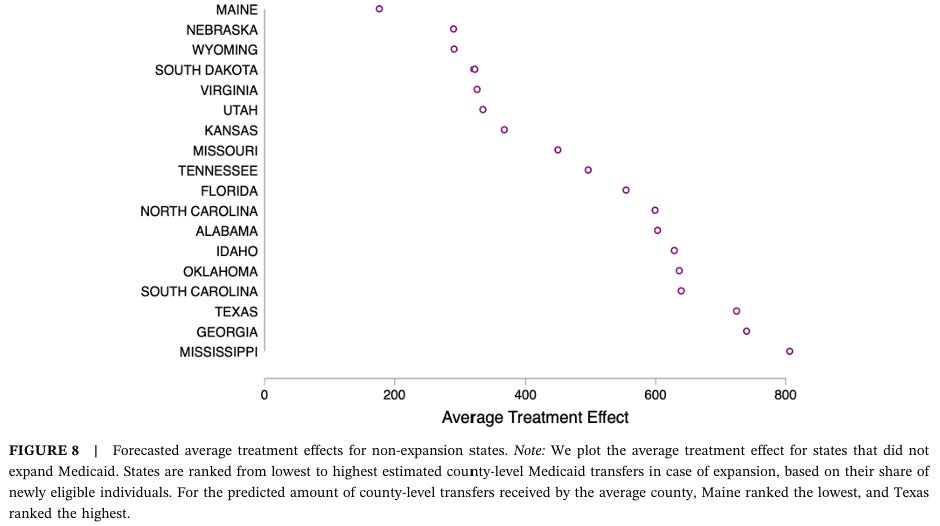
Montenovo’s work references additional research suggesting fiscal concerns expressed by non-participating states have not materialized:
“Gruber and Sommers (2020) found most of the increase in Medicaid expenditures in expansion states is due to new funding from the federal government. There is little evidence this increased spending ‘crowds out’ spending on other areas of social policy… and they detect no change in state funds, nor reductions of spending on education or other programs [due to Medicaid expansion].”
Currently, 10 states continue not to participate in Medicaid expansion: Alabama, Florida, Georgia, Kansas, Mississippi, South Carolina, Tennessee, Texas, Wisconsin, and Wyoming.
Montenovo’s research, Redistributive Effects of Federal Medicaid Outlays Across Counties: Evidence From the ACA, appears in issue 46(2) of Public Budgeting and Finance.
