

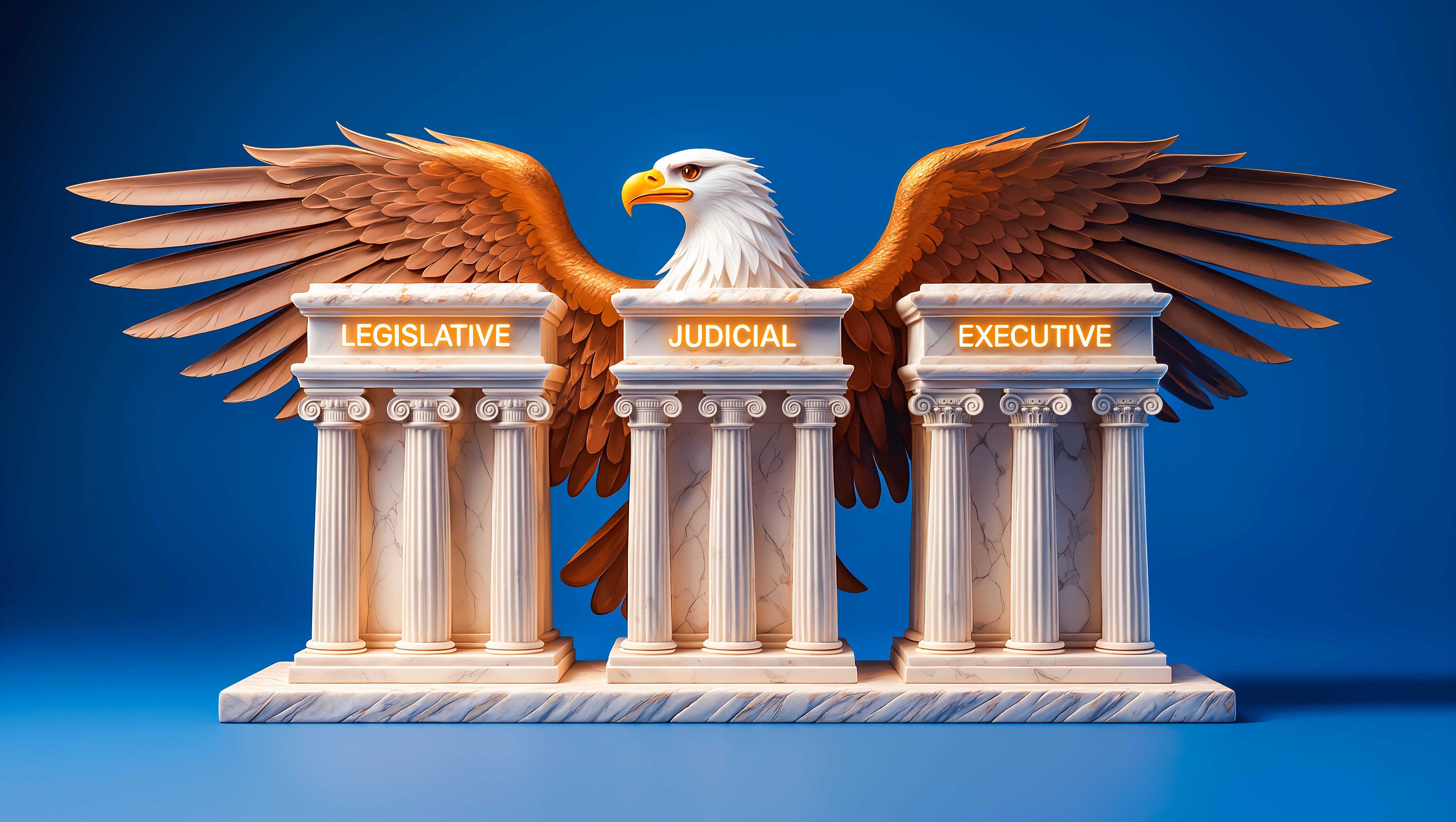
When people picture the budget process, they may picture noisy fights over spending bills and government shutdowns as “resolutions” to disagreements.
But increasingly, President Trump has withheld, cancelled, or slow-walked spending already approved by the legislature — the branch which is constitutionally in charge of the power of the purse.
In his recent Public Budgeting & Finance article, University of Maryland public policy professor Phil Joyce argues these actions are not just technical budget skirmishes, but a direct challenge to the balance of power between Congress and the president.
I spoke with Joyce about how presidents are supposed to decline to spend congressionally approved funding, what Trump is doing instead, and potential implications he sees for the future of our democracy.

Nick Baird (NB): Your recent paper, High Noon for the Separation of Powers?: Trump and the Impoundment Control Act, deals with a lot of legal and historical complexity. For readers who don’t follow closely, could you start with the basics? How are presidents supposed to decline to spend congressionally approved funding, and why are Trump’s recent actions concerning in that context?
Phil Joyce (PJ): The refusal to spend money that’s been appropriated by Congress is referred to as impoundment, and you really have to go back to President Richard Nixon to understand. He had the habit of refusing to spend money that had been approved, picking and choosing which programs he wanted to spend on and which programs he didn’t. And there were a couple problems with that. First, it made Congress mad. Second, it was deemed by the courts to be illegal and unconstitutional.
So in 1974, Congress passed the Congressional Budget and Impoundment Control Act, which reasserted the role of Congress in the budget process, and in their mind, made their role consistent with what the Founders intended.
It set out a specific process and 45-day timeline where the President can request Congress cancel spending that’s already been appropriated, but if Congress doesn’t act, the President is compelled to go ahead and spend that money.
NB: So, in short, it’s a way to restrict a president’s ability to ignore what Congress has already decided? Is that right?
PJ: Yes. Although I would say that the courts already restricted that. It’s not the Impoundment Control Act that actually prevents the President from refusing to spend money that’s been appropriated. It’s the constitution that does that–or at least that is what the courts have decided in the past.
But what the Impoundment Control Act said was, okay, let’s say you’re a president who wants to refuse to spend money. Here’s a process you can use to try to do that.
NB: I see. So my reading of your paper is that, since the Impoundment Control Act has been on the books, it was mostly inconsequential. Between 1974 and 2020, presidents proposed about $100 billion worth of rescissions, and about a quarter of those were accepted by Congress. Pretty negligible in the grand scheme of federal spending.
I know it’s difficult to estimate, since the Trump administration turned off the Office of Management and Budget website that tracked disbursements, but just for comparison, could you estimate how many rescissions the Trump administration has attempted since he returned to office?
PJ: We actually know that because they only proposed rescissions once – about $9 billion for a combination of foreign aid and Public Broadcasting. But the Trump administration isn’t really following the Impoundment Control Act at all. By and large, he’s just refusing to spend money.
The much larger issue is all the spending the Trump administration has unilaterally canceled, which has not gone through the ICA process.
Nobody has a precise estimate, although I will say the Senate Appropriations Committee estimated there was something like $430 billion worth of funds that have been provided for by Congress, and in one way or another, the Trump administration has failed to spend it.
NB: So they essentially blew past over two decades’ worth of similar rescission activity in just under a year, by just choosing not to spend the money?
PJ: Correct. Although I think, arguably, they also exceeded the total amount that previous presidents have illegally withheld by almost the entire $430 billion [since they’re not following the process laid out by the ICA].
It’s part of a larger effort by the Trump administration to exercise executive power. There’s this theory — Unitary Executive Theory — that basically says when the President pledges to “faithfully execute the laws,” then it means, in effect, if he finds a law he thinks would result in spending money inefficiently, it’s within his power to just refuse to spend money, regardless of the fact that money has been provided for by Congress.
NB. Which brings me to my next question. In your paper, you traced a long line of arguments supporting both impoundment and the Unitary Executive Theory. Do you think those are genuine constitutional legal debates? Or just post hoc justifications for the Trump administration to do whatever they want?
PJ: We’ll find out, I suppose.
I’ve been careful not to use words like unconstitutional in describing what they have been doing because what’s “constitutional” is ultimately whatever the Supreme Court decides. The only thing I will say is that the things they’re doing have always been deemed to be unconstitutional in the past, and that the lower courts have stepped in and supported the challenges to many of these impoundments.
However, we don’t really have a definitive decision by the Supreme Court, but so far, they’ve tended to be pretty deferential to Trump’s claim of additional power.
There’s also a couple cases that don’t involve impoundment that I think will give us some signals. One of them is about President Trump’s authority to impose tariffs [Learning Resources vs. Trump], and the other one has to do with whether President Trump is within his authority to fire people who were appointees of independent commissions [Trump vs. Slaughter].
Historically, commissions haven’t been under the direct control of the President. But it’s really hard to say, in the end, how the courts are going to rule on this. What you can say is these actions are inconsistent with past legal rulings.
So to go back to your question about these arguments, whether these are legitimate legal arguments or not, I guess you’d have to say they’re legitimate legal arguments that are inconsistent with all past legal arguments that have tended to win the day in this arena.
NB: Wow. That’s a really tactful way to put it.
PJ: Hah. I try not to be tactful, so I’ll try to work harder on that.
NB: Thanks, hah. Let’s move on a little bit. Help me understand something that doesn’t quite make sense. The Impoundment Control Act means that the President may delay disbursements by 45 days, but if Congress fails to act within that time frame, their inaction means money has to be distributed. If this is how the law is laid out, how is the Trump administration doing what they’re doing to begin with?
PJ: To move back to not being tactful, I would say they’re not following the law. I mean, that’s the argument, right? That they’re illegally withholding funds without going through the process that is laid out in the law.
What happens in cases like that is the Government Accountability Office (GAO) is empowered, as a representative of Congress, to look into matters where the President may be engaging in unilateral impoundments. It’s supposed to then tell Congress, hey, just so you know, here’s a case where you appropriated money, and the President is refusing to spend it, and he hasn’t followed the procedures.
We don’t know exactly how many of those cases are underway, but we do know the head of the Government Accountability Office, the Comptroller General of the United States, gave testimony to the House Appropriations Committee maybe four months ago, indicating they had 39 investigations of violations of the Impoundment Control Act.
I think about 10 of them have been decided, and it’s a mixed bag of violations, no violations, and partial violations.
Interestingly, the GAO is empowered to bring suit against the administration for illegally impounding funds. And even though they have these investigations underway, and some of them have found they’ve illegally withheld funds, they’ve chosen, at least so far, not to pursue actual legal action against them.
NB: That’s what I was going to ask next. When they find that he has broken the law, what happens? What’s the recourse?
PJ: Well, the GAO is choosing not to pursue the recourse. Arguably, there are people who have been harmed by the refusal to spend money, who would also have standing in court to sue. But that’s not the case.
There was a weird court decision, that’s my opinion at least, sometime in the last few months, that said the GAO was the only entity that could actually bring suit.
To me, that’s an odd reading of the law. It feels to me like having standing to sue is normally related to whether you can identify a party who has actually been injured.
Let’s take the Agency for International Development (USAID), which has been essentially totally abolished, unilaterally, by the Trump administration, as an example. There are nonprofits that used to get money from USAID under appropriations that were essentially canceled. Arguably, they should have standing to sue. But whether they choose to do that or not is another question.
NB: That is a weird decision. For what it’s worth, I agree. But let’s move on a bit. In our interview in April, you mentioned you wondered to what extent the other branches of government would stand up to an executive trying to exert extreme levels of authority. It’s December now. Since then, to what extent have you seen them stand up for themselves?
PJ: Well, certainly relative to the power of the purse, not very much.
What’s happened since the last time we did an interview was the longest shutdown in history. But it was really the Republicans in Congress, because they’re in control, who haven’t been standing up to the President. The Democrats are effectively powerless to do anything.
The one place where Democrats did have power, was appropriations, since it can be filibustered in the Senate. The argument they were making was primarily about subsidies under the Affordable Care Act. But everyone I have talked to says that the other thing really behind this was anger, on the part of the Democrats, that the President had been running roughshod over Congress.
There are also some slight indications that there are limitations to what the Republicans in Congress are willing to put up with. In particular, during the shutdown, the president said he thought the Senate should just get rid of the filibuster. And the majority leader, Senator Thune, said well, we’re not going to do that.
And this may be obvious, but one of the reasons is because they may one day not be in the majority, and if you’re not in the majority, then you would like to have some degree of leverage. So in the short run, getting rid of the filibuster will let you do something right now, but in the long run, it may not be a good thing.
I’m really waiting to see what happens with a couple of these cases we talked about earlier, though. I actually think the lower courts have been quite direct in many cases in standing up to some of the more extreme things the administration is doing.
But the Supreme Court, while it hasn’t made a final ruling on many things, actually let a lot of the administration’s actions go forward through the emergency docket. That’s where basically, a lower court says you have to stop doing this, the Supreme Court says you can keep doing it until we make a decision, and since many of these cases haven’t come up at the level of the Supreme Court, the administration can keep going until they do.
NB: What do you think about the case where Trump fired the head of the FCC? They heard oral arguments on that this week. Could you lay out the potential outcomes, and the stakes, of that case?
PJ: Well, we’ve had a professional civil service since the late 1800s, and I really think what’s at stake here is the notion that we have an independent, relatively merit-based, expertise-based civil service that doesn’t ebb and flow with whoever the president happens to be.
There are a whole set of people who are political appointees, some of whom are confirmed by the Senate and some of whom are not, where there is no question about whether the President has the legal authority to fire.
But the question comes down to people who are not political appointees, and this includes civil servants in some cases, and also includes people who are appointed to independent commissions where the appointment staggers across multiple administrations.
So if the President comes in and sees some of these people and doesn’t like the fact that they’re there, the question is, can he go ahead and fire those people? As opposed to waiting for their terms to expire?
With some of these commissions, by law, there are supposed to be members from both parties. So part of the question is, does he have the ability to get rid of members that aren’t from his own party?
The broader issue is an extension of what we talked about earlier — Unitary Executive Theory — which is how much control does the President have over the executive branch? The argument made by the administration is that the President is the chief executive of the country, and therefore, anybody in the executive branch should be subject to the will of the President.
But if you take this to its logical extreme, it would mean we’re returning to the spoils system.
NB: One last question before we go. We’re spending a lot of time talking about what is and isn’t legal. But at least to me, it seems evident that Trump himself doesn’t start with what’s legal, but rather, what do I want? Which legal questions can I pull, however tenuous, and if there are none, how can I slow walk the courts to buy myself time to get what I want?
So, if the administration doesn’t care what is and isn’t legal, why should we?
PJ: Well…I think we should care, because the founders cared.
When they set up the United States under the Constitution, the thing they were most afraid of, if you go back and read the Federalist Papers, was concentrated executive power. And the reason they were worried about that is because they had just fought a revolution against a king.
I don’t have the quote on the tip of my tongue, but Madison wrote that the power of the purse was essentially the most effective way to constrain the excess of executive power. So they gave Congress the power of the purse for a reason. And anything that moves us in the direction of more executive power, is inconsistent, in my mind, with the separation of powers and the checks and balances that were set up under the Constitution.
We can decide, if we want, that they had it wrong in 1789. There are reasons to believe our system is very inefficient, and it would be more efficient if you just gave the President more power. But in my mind, we should do that intentionally. We should do that because we had a conversation and said well, okay, there have been some problems happening in the last ~236 years since the Constitution was ratified, and one of the big problems is the President doesn’t have enough power.
But I don’t think that should happen because a particular president decides to grab power. It should happen because we are consciously deciding.
Phil’s article, High Noon for the Separation of Powers, appeared in the October 2025 issue of Public Budgeting & Finance.
Our stories may be republished online or in print under Creative Commons license CC BY-NC-ND 4.0. We ask that you edit only for style or to shorten, provide proper attribution and link to our website. AP and Getty images may not be republished.
