


Literature on employee satisfaction indicates that happier employees tend to stay longer; a boon for private companies and civil service organizations alike. While agency leaders may not be able to fix budget dysfunctionality, as those issues lie within the control of the President and Congress, it does remain worthwhile to understand how the issue affects employee morale.
Drawing on survey and archival data from 2005 to 2020, researchers Nathan Favero, Carla Flink, and Tingli Qu evaluated in a recent study how budget size and uncertainty are associated with federal employee attitudes. Their work uncovered evidence that larger budgets improve job satisfaction, while not finding evidence that budget delays or lapses have an impact.
“We were surprised that budget uncertainty did not lower employee satisfaction,” Flink shares. “In recent years, they’ve become accustomed to these types of disruptions and are resilient to fiscal year uncertainties. In other words, as long as future resources are visible, they can remain confident that after the disruption, they’ll be able to move forward and work toward their mission.”
The Core Finding
Favero and his team considered over a dozen explanatory variables, including the number of weeks a budget spends in continuing resolution, funding gaps (government shutdowns), and employee demographics. Analyzing approximately 15 years of data, they conclude that the magnitude of resources available matters, but not the uncertainty of funding.
Employee Satisfaction Over Time, 95% Confidence Intervals
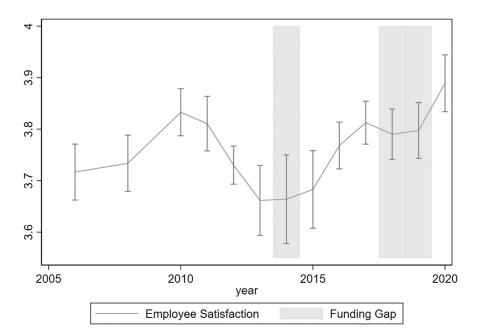
For every standard deviation increase in the 3-year average budget change, researchers found a change of about one-fifth of a standard deviation in satisfaction. However, despite 3 years of the data set containing government shutdowns, no obvious decline in satisfaction was discovered for those years.
While the reported fluctuations were relatively small (satisfaction scores ranged between just ~3.65 and ~3.9 on a 5-point scale), their cause is still worth investigating. Answers on a five-point scale can only vary so much, and subtle changes can indicate important shifts in employee sentiment.
Why Doesn’t Uncertainty “Bite”?
Researchers speculate that federal employees are resilient, expect budgetary turbulence, and potentially develop coping mechanisms around the uncertainties of their professional environment.
Flink frames the discussion:
“An on-time budget does not make up for budget cuts, but a late budget could be overlooked if more resources are made available.”
There’s also statistical logic at work.
“Another possibility is that some employees do feel frustrated because of budget delays, but given how persistent the delays have become, the negative effects are already baked in and do not fluctuate much from year to year.”
For public service leaders, the actionable takeaway is that visible and adequate resources do more for morale than smooth and certain approval of appropriations. Anxious administrators can take some comfort knowing their workforce has weathered and overcome these storms in the recent past.
However, the study carries an important caveat raised by University of Michigan Professor Donald Moynihan after his review of the research. “The study focused on a period before recent upheaval (starting in 2025), and in the current climate, federal employee morale is abysmal. They’ve seen significant cuts for no clear reason in ways that seem designed to limit their ability to do their job.”
Moynihan also pointed to a meaningful distinction the study itself gestures toward.
“Some research shows shutdowns hurt employee morale and perceptions of agency effectiveness. This isn’t just budget uncertainty, but experiencing a tangible effect of the inability to pass a budget: employees are sent home, or asked to work without pay.”
Favero and collaborators conclude by suggesting ways researchers may support civil service leaders.
“Future research can consider how good agency management can help performance and job satisfaction in times of budget uncertainty. Research like ours can also be extended to other parts of the world. It is not unusual for countries’ political systems to experience substantial stress. Where political upheaval leads to budgetary disruptions, employees may experience personal disruption at work and alter their job satisfaction, although various contextual factors may shape the resilience of employees to such disruptions.”
This article, “US Federal Budgets and Federal Employee Job Satisfaction,” is published and currently available to read for free in the online edition of Public Budgeting & Finance.
