


Publicly financed organizations face a similar challenge: how to maximize public benefit given their available resources. For public schools, this means fulfilling the requirements of balancing a stable year-to-year fiscal condition with the demands of quality education for children. When revenues fall short, those obligations collide.
Research published in Public Budgeting & Finance by Paul Thompson and Muhammad Aatir Khan examines this question via their innovative analytical approach. Examining student achievement before and after Ohio school districts receive state-issued fiscal stress labels, a budget deficit triggered designation obligating districts to enact financial recovery plans, their approach yields a treatment variable from which one can likely identify causality with subsequent, detrimental student outcomes.
“These achievement declines are likely driven primarily by spending cuts necessitated by the fiscal stress labels themselves, instead of other potential factors such as student composition or reduced teaching effort,” Thompson states.
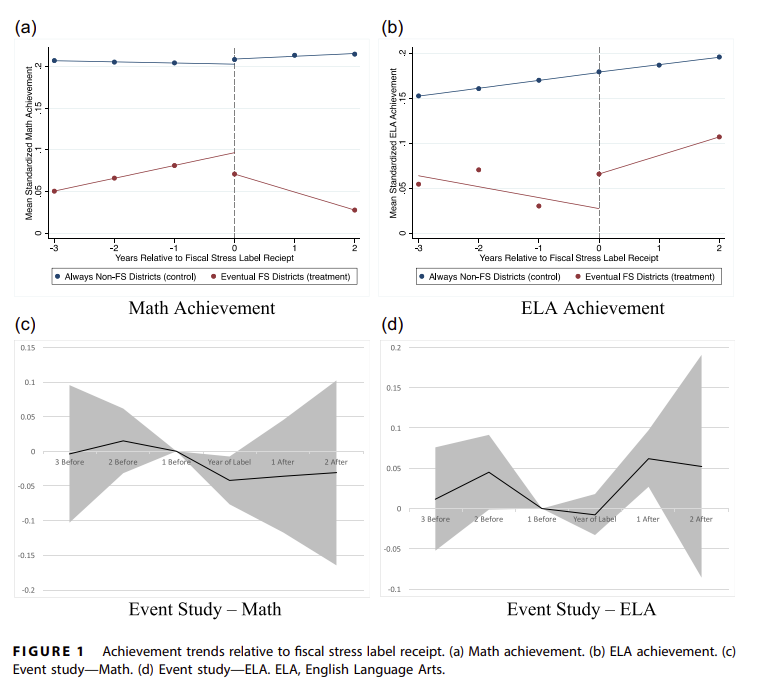
Their analysis indicates that student achievement on math and English Language Arts (ELA) declines by between 0.038 and 0.048 standard deviations after schools receive the fiscal stress label. This means that districts enacting budget cuts exhibit modest drops in student performance, a finding well in line with contemporary education research.
“Recent evidence [from research literature] points unequivocally to the notion that greater educational resources yield better student outcomes,” Thompson writes.
However, the finding comes with an important asterisk, as the authors themselves supply in their article, and as discussed below. Still, this consideration should not distract from the core story of this research: when schools are forced to tighten the belt, student performance is negatively impacted.
Reviewing Prior Research Examining Public Finance vs. Educational Attainment
Thompson and Khan’s research doesn’t exist in a vacuum. Instead, they’re contributing to a broad and fairly consistent body of work examining how public school spending relates to student outcomes, with the consensus view that money matters.
“If these [budget] reductions are primarily targeted towards wasteful spending,” Thompson begins, then achievement is unlikely to be affected, but if they lead to reductions in the quantity and/or quality of school inputs, that suggests student achievement would fall.”
Literature on this subject already examines the situation from many angles: budget impacts created by the Great Recession, adoption of bond and operating tax levies, construction subsidies, class sizes, school closures, year-round school, 4-day school weeks, elimination of teacher incentive programs, removal of universal meal programs, charging student families for textbooks, and more.
Thompson and Khan’s review of these recent studies estimates that for every $1,000 per pupil spending cut, student achievement declines by a factor between 0.045 and 0.2 standard deviations. For these purposes, the “standard deviation” reflects the difference between specific school districts dealing with reductions in expenditures and the overall average across districts in Ohio.
By examining fiscal stress labels specifically, researchers employ a useful analytical technique to reexamine the hypothesis tied to the results of prior research. This method provides a meaningful way to examine the sharp, time-bound, policy-induced shocks with the means available to the objective, quantitative tools available to social scientists.
Why Districts Get Labeled, and How They Respond
Based on 5-year forecasts of annual expenditure and revenue projections, public school districts in Ohio with deficits between 2% and 15% of general fund revenue receive a fiscal oversight label. Districts with these labels are then required to develop fiscal recovery plans, under review by the Ohio Department of Education.
Those predicting deficits of 15% or more are given an emergency label. In these circumstances, districts cede fiscal authority to a state commission that, in pursuit of a balanced budget, may eliminate employees irrespective of employment contracts and collective bargaining agreements. The commission also reviews all revenues/expenditures and gains final approval on tax levies and debt issuances,
During Thompson and Khan’s ten year research window (2008-2018), approximately 14 of Ohio’s 611 school districts were assigned a fiscal distress label. Identified districts responded by cutting average per pupil expenditures by 9.4%, with approximately 59% of the reductions tied to reduced capital expenditures and approximately 41% from lessened operational budgets.
Evaluating Impact on Student Performance
Thompson and Khan are transparent about an important asterisk, as their results are statistically significant under one mathematical technique, but not the other. The two-way fixed effects estimate applied in this research, a method known to be biased when different districts get treated at different times, was significant, while their stacked difference-in-differences approach meant to address that bias, was not.
Nevertheless, their two-way fixed effect did report findings worth exploring with respect to districts responding to the fiscal oversight label.
Overall student achievement declined by 0.038 and 0.048 standard deviations.
Fiscal stress labels closed the white-black achievement gap by 0.05 and 0.16 standard deviations, paradoxically, due to increased performance by African American students following distress labels.
The male-female gap in math remains unchanged, but grows by 0.015 and 0.044 standard deviations in ELA.
Data indicate no change along socioeconomic lines.
Why Wait?
Thompson and Khan’s research adds context to an already well-tested hypothesis. Do school budgets impact student outcomes? Yes. Yes they do.
However, parallel fiscal stress label research invites a question that optimists may find worth considering.
Such labels trigger an average 9.4% per pupil expenditure reduction (across all categories). At the same time, stress labels also increase the likelihood voters approve a tax increase referendum by 15-23% and increase per pupil local tax revenue (for operating expenditures) by 7.6% to 11.1%.
In other words, if a district can raise revenue once distress becomes official, why wait for a crisis?
Thompson and Khan don’t make that argument themselves. Additional research literature on this subject is increasingly clear that well-directed spending improves student outcomes. Therefore, resources collected by recovery plans can, in principle, be secured before deficits force anyone’s hand.
“While it is necessary to rectify budget deficits,” Thompson concludes, “the primary objective of school districts is to maximize student success. Balancing these two objectives is a challenge, as many cost-saving measures yield negative achievement impacts. From a student achievement perspective, it is imperative that these interventions take care in minimizing reductions to expenditures that are directly related to student instruction.”
Thompson and Khan’s article, Impacts of fiscal stress labels on student achievement and achievement gaps, appears in issue 45(2) of Public Budgeting and Finance.
