


During the pandemic, federal and state budgets were in tension with public health priorities.
Every year, states disenroll millions of people from Medicaid for eligibility reasons, or because renewal paperwork goes unreturned. COVID-19, however, created an emergency where Congress didn’t want enrollees losing coverage during its duration. Since the Federal government can’t force states to change their Medicaid procedures, it offered a deal: in exchange for promising continuous coverage, Washington would increase Federal Medicaid Assistance Percentages (FMAP) to states by a flat 6.2 percentage points.
All fifty states chose to opt in, anticipating the increase in assistance would cover associated benefit costs.
Recently published ex post analysis by Jeffrey Clemens and Anwita Mahajan examines whether this deal amounted to an unfunded mandate, or provided funding sufficient to cover the additional costs. Their work finds that while overall state revenue collections increased by $11 billion compared to costs (as of 2025), the distribution was unequal, contributing to surpluses for some states and deficits for others.
“Given the scale of Medicaid, the FMAP increase represented substantial fiscal assistance, but it was tied to a mandate whose costs were uncertain and potentially increasing over time,” Clemens writes.

Based on Clemens and Mahajan’s analysis, some states received as much as $838 in excess funding per capita, while others received $594 too little.
What Explains the Variation?
A state’s political lean, approach to unwinding, or severity of the pandemic showed no statistically significant effects. Rather, a state’s effective federal match rate dictated whether or not it came out ahead.
“The baseline parameters governing the federal government’s share of states’ Medicaid expenditures emerge as a key driver of the extent to which the continuous coverage requirement can be viewed as an unfunded federal mandate,” Clemens writes.
Each state has its own FMAP; the share of Medicaid expenses the federal government covers. It ranges from a minimum of 50% to a statutory maximum of 83% and scales based on a state’s per-capita income. So a state with a 50% match pays half the cost of every Medicaid enrollee, while a state with a 75% maximum pays just a quarter.
By contrast, the incentive was a flat 6.2 percentage increase, applied to all traditional enrollees. In other words, the incentive was designed to be simple to administer rather than perfectly scaled to the true costs a state might incur.
The Affordable Care Act Medicaid expansion adds a significant wrinkle as well. Some states did not opt in, but since the federal government covers 90% of ACA enrollee medicaid costs for those that did, opting in significantly raises a state’s effective Medicaid match rate.
The Timing Issue
While revenues from this incentive stopped as the Pandemic ended, the costs for coverage provided by the states didn’t.
The FMAP matching increase remained in full force until March 2023, and gradually phased out through January 2024. However, excess Medicaid enrollees remain (those enrolled only because of the continuous coverage rule), and states still have to cover those costs.
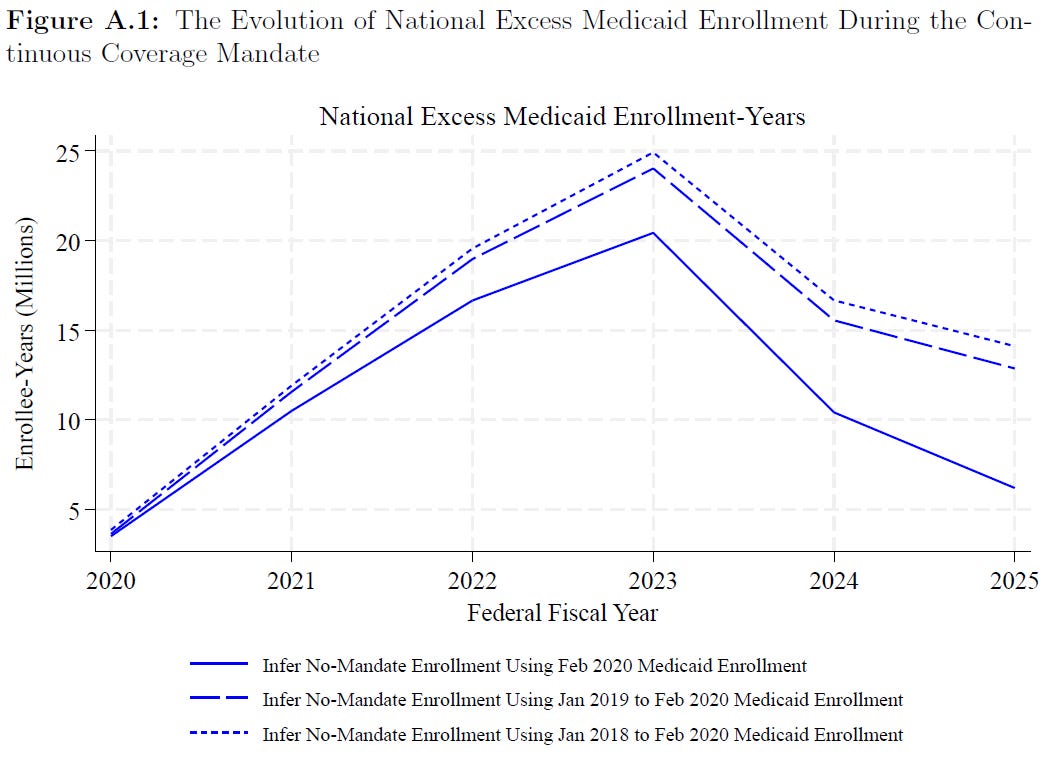
As the graph above shows, excess enrollees persisted beyond January 2024, when the 6.2% FMAP fully phased out.
At the end of 2023, states had collected $58 billion over and above excess Medicaid costs attributable to continuous coverage rules. But by the end of 2025? That figure was just $11 billion (the figure authors reported at the time of publication), and as of the end of 2026, the net surplus is likely even less.
What Comes Next?
Effective Medicaid matching rates are significant explanatory variables, but much of the variation still remains unexplained. Further research to uncover these mechanisms can help inform the design of future fiscal interventions. Additionally, the Pandemic serves as a lesson in how difficult it is to design policy in real time. Understanding how aid and costs actually line up carries implications for how future health policies may be designed.
Clemens and Mahajan’s article, An Unfunded Mandate? Medicaid Continuous Coverage Requirements and State Fiscal Burdens During COVID-19, is currently published as open access online at Public Budgeting & Finance and will be included in an upcoming issue.
