


When California’s 11% excise tax on firearms, gun parts, and ammunition took effect in 2024, legislators had already allocated $161 million in projected revenue to a variety of projects. In its first fiscal year, however, the tax collected just $57.2 million.
Colorado’s experience is proving similar. Their new 6.5% firearm tax was projected to raise approximately $36 million, but has only collected ~$17 million in its first fiscal year.
According to research published in Public Budgeting and Finance by Joseph Eisenhauer of the University of Detroit Mercy, the shortfall (as well as an accurate forecast) was predictable.
California and Colorado projections assumed perfect price inelasticity, despite economic theory’s well-understood insight that higher prices reduce demand. Applying published data on firearm consumer price sensitivity, Eisenhauer’s article arrives at forecasts that land almost exactly on California’s actual collections, as well as Colorado’s.
The findings of this research extend well beyond firearms.
“It is questionable whether legislators or voters would have supported these new tax measures if more accurate projections had been issued,” Eisenhauer writes. The same holds for any fiscal policy. When costs, revenues, or benefits are misstated, lawmakers and the public may find themselves constructing debates on numbers that were never realistic to begin with.

Why Assume Consumers Wouldn’t Buy Less?
The original forecasts display strong cases of irony. One long-standing argument for taxing firearms is that higher prices discourage purchases, and thus lead to reduced gun violence. Indeed, Eisenhauer examines that hypothesis in other research, and finds affirmative evidence.
Yet official estimates published by both California and Colorado assumed purchases wouldn’t change at all. Jesse Gabriel, a sponsor of the California excise tax bill, even knew this ahead of time. During a 2023 floor speech in the State Legislature, he stated: “[We estimate] this bill would result in additional excise tax revenue of $159 million in 2024-25… [we note] that this estimate does not account for… any behavioral changes in sales that may result from the enactment of this bill.”
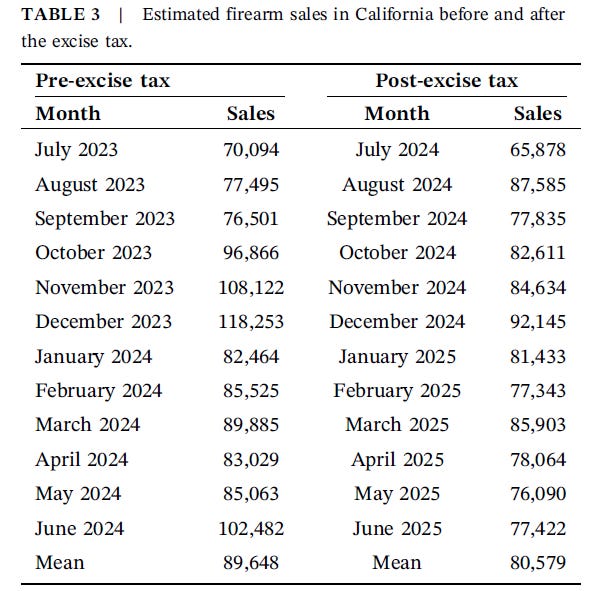
Eisenhauer’s research speculates on three possible explanations for this disconnect.
The least likely, he argues, is that forecasters simply don’t understand the concept. Tax policy passes through many analysts, legislators, and stakeholders. The odds that none of them understood the implications of a tax increase are vanishingly small.
A more plausible explanation is missing data, as no state-level estimates of firearm price elasticities were available when these bills were being debated. However, national estimates have been available for more than two decades; Eisenahauer used them to produce a forecast that was within 1% of perfect accuracy.
His third explanation is political. Advocates in both states were happy to discuss potential revenues (and the benefits of the programs they’d fund), but were hesitant to advocate for reduced gun sales. In fact, during California’s public discussions, Ari Freilich, state policy director for the Giffords Law Center, described the tax as “not looking to punish anyone, or to deter anyone from purchasing weapons.”
The Takeaway
“Regardless of motive,” Eisenhauer writes, “accuracy is important. Advocates of gun rights should rightly be suspicious of tax revenue estimates that fail to incorporate price elasticities. And proponents of gun taxes should be wary of losing credibility by over-promising and under-delivering on tax revenues.”
For states weighing new excise taxes, on firearms or any other good or service, the behavioral channels of such a decision are well understood. Precise data may not be available, but an elasticity of zero is still an assumption, and very likely the least defensible one available.
Eisenhauer’s article, Fiscal Effects of Firearm Taxes in California and Colorado, appears in issue 46(1) of Public Budgeting and Finance.
