


It’s tempting to view a municipality’s creditworthiness as a function of economic factors outside its control. City and town councils cannot legislate their way into stronger tax bases, and their managers do not possess the ability to force Moody’s and other rating agencies to overlook unfunded liabilities as they face the need to finance critical infrastructure maintenance, improvements, and expansions.
Christine Martell rejects the premise that municipalities cannot influence their credit ratings, asserting that local jurisdictions have considerably more ability to act in constructive ways to enhance this key evaluation of their fiscal performance, irrespective of underlying economic conditions.
In the recent study, Is City Agency With Financial Management Levers Critical for Credit Ratings? An Analysis of Information Transparency and Certification, Martell and her collaborators explored what municipal managers can do, within the context of governance practices, to positively impact their credit ratings, presenting themselves as more attractive to bond investors. Her finds offer a highly actionable takeaway:
“No matter the national context and intergovernmental fiscal relations, (municipalities) can have agency in improving their credit ratings by investing in good accounting and auditing systems.”
Study reviews 10 Years of Measurable Results
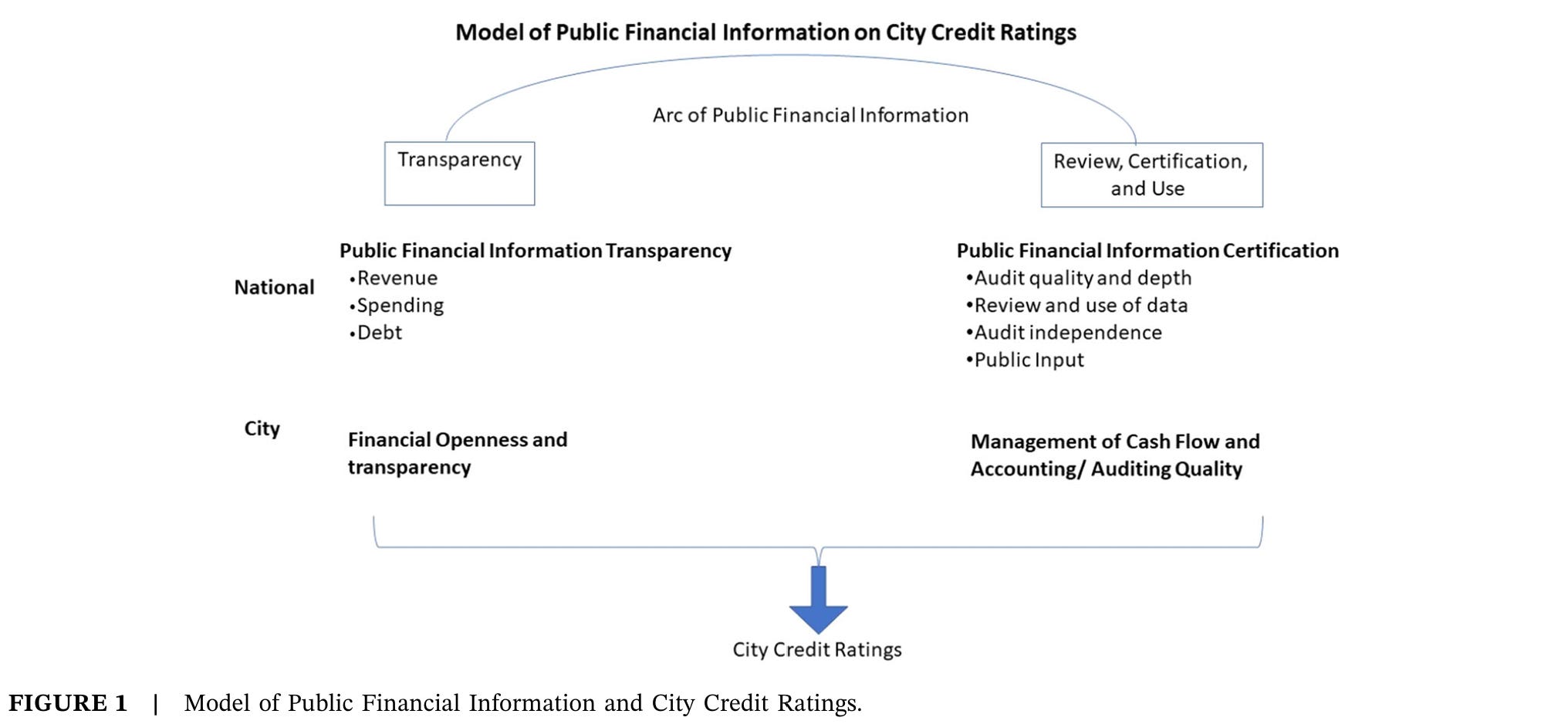
Martell and collaborators analyzed credit rating reports for 50 cities across 25 countries, over a 10-year period, drawing on assessments from Fitch, Moody’s, and Standard & Poor’s, to explore how much control city governments have over credit ratings. Their study specifically examined the relationship between credit ratings, financial transparency, and certification.
“Our analysis wasn’t focused on the well-known quantifiable factors of credit quality,” Martell writes. “Rather, we quantified the fuzzy, mushy area of financial management in an effort to better understand how these factors relate.”
Economic and fiscal factors matter of course, but municipal managers are limited in their direct influence on them. Instead, the research team zeroed in on frameworks within the control of the surveyed jurisdictions, examining both municipal-level and national-level versions of transparency and certification.
Key Findings
Analysis by Martell and her team show that municipalities benefit most when they credibly certify the financial information they disclose.
“We expected transparency and certification to be equally impactful,” Martell shares, “but (certification is) even more important than transparency. It goes to show the value of producing post-fiscal year analysis.”
Transparency matters, but the research analysis shows it is insufficient on its own.
Publishing budgets and financial reports mean very little if independent verification of their accuracy is unavailable.. Certification closes the loop, and bond markets favorably respond
In addition, certifiable municipal-level information can serve to override national contexts.
Research by Martell and her team did find that municipalities in countries with stronger national financial oversight systems did achieve higher credit ratings, but only when national factors were evaluated in isolation. Once local level practices were incorporated into the analysis, the significance of national factors was largely reduced.
“There were some surprising nuanced findings, and one is how important city-level certification is!”
For municipalities in countries with weak or inconsistent national financial oversight, this study’s findings reinforce the importance of strong local accounting and auditing practices. This is further justification for action at the local level to mitigate the potential of weak national rules to negatively affect credit ratings.
Martell interprets this finding, writing: “financial markets may prioritize the internal, localized information systems at the (municipal) government level over those of the national context, giving (municipalities) a very clear lever and responsibility to attain their highest credit quality.”
Advocating Greater Focus and Investment for Accounting and Auditing
It is not surprising to find municipalities treating certification and auditing as compliance burdens imposed by higher levels of government and advisory boards. Martell’s research suggests that this belief comes with serious costs.
Independent audits, rigorous accounting standards, and timely financial reporting will satisfy legal requirements, and by influencing higher credit ratings, they can materially lower borrowing costs for future issuances and projects.
Supporting research cited by Martell establishes a benchmark on the financial impact of this relationship. Governments with material weaknesses in internal controls face borrowing-cost premiums of 10-18 basis points (bps), and audit delays can increase borrowing costs by 6 bps for every 100 days the assessment is delayed.
Rigorous audits are certainly an administrative or legal necessity, and they also provide a basis for respectable credit management and enable measurable savings.
The Catch: Transparency Can Cut Both Ways
One counterintuitive finding from the study is seen at the national level, with greater transparency being associated with lower credit ratings, not higher ones.
Martell shares a possible explanation:
“Transparency, especially spending transparency, acts as a market disciplining tool, whereas certification seems to broaden market opportunities.”
This should not discourage municipalities to minimize or avoid transparency. Instead, the takeaway is these jurisdictions should ensure disclosure is credibly paired with a certification infrastructure.
Lessons for Municipal Managers & Governing Bodies
The study’s central finding is that financial markets reward municipalities establishing and performing rigorous, independent verification of their financial information.
Martell’s research doesn’t ask local leaders to ignore economic fundamentals, nor does she pretend structural fiscal constraints do not exist or will not impact credit ratings. Changes adopted by rating agencies in 2024 and 2025 did apply higher value to economic conditions.
Nevertheless, municipal managers and their governing bodies should look carefully at what’s within their control, particularly the capacities and knowledge levels of their and take it more seriously than many currently do.
This research is published and available to read in Issue 45(3) of Public Budgeting & Finance.
